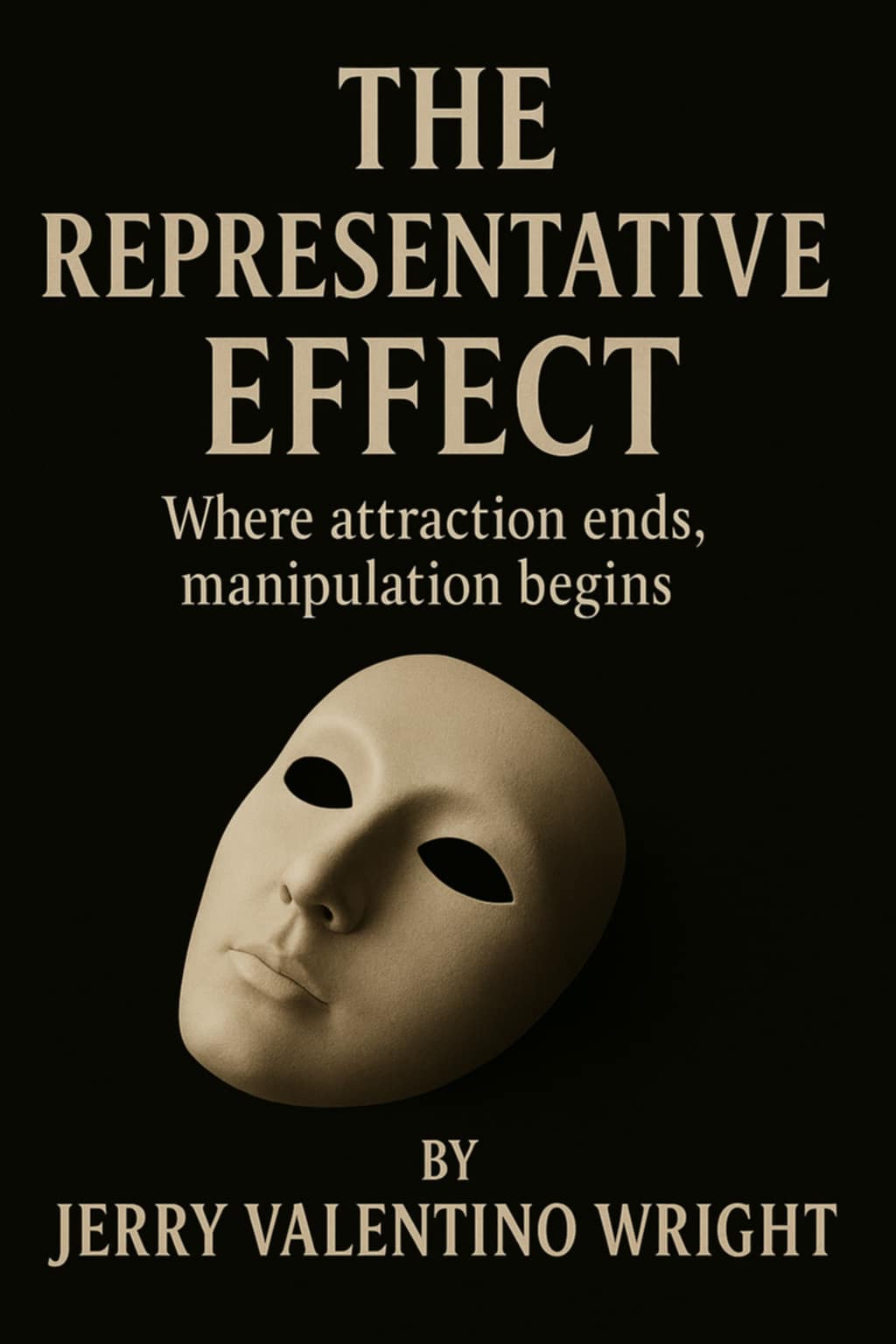
The Representative Effect

The Representative Effect

Where attraction ends, manipulation begins

By Jerry Valentino Wright

Self-HelpRelationshipsPsychology

Scroll down to read the full book

Dedication

To everyone who ever gave love to the wrong person—not because you were weak, but because you were willing.

To those who stayed too long, tried too hard, and blamed themselves for someone else's mask.

This book is your mirror, your shield, and your reminder: You were never the problem. Now, you're the solution.

Introduction

Let me be clear from the start: this book isn't about bashing anyone.

It's not about gender wars. It's not about revenge. It's not about becoming cold, jaded, or closed off.

This book is about awareness.

Because when you understand how people operate—how they present themselves versus who they really are—you stop getting played. You stop investing years into people who never planned to stay. You stop confusing chemistry with compatibility. And you stop blaming yourself for what someone else hid from you.

The Representative Effect is a term I use to describe the version of a person you meet at the beginning of a relationship—or even a friendship. It's the curated version. The highlight reel. The "best behavior" self that shows up during the attraction phase.

And that version? It's not always a lie. But it's also not always the whole truth.

Some people genuinely grow into the best version of themselves inside of love. But others? They use that early version as bait—a temporary disguise designed to hook you emotionally before revealing who they really are.

By then, you're invested. Attached. Maybe even in love.

And that's when the mask starts to slip.

This book will teach you how to recognize the mask before it falls off. It will give you the tools to ask the right questions, notice the red flags, and protect your peace without becoming paranoid or emotionally unavailable.

Because the goal isn't to stop trusting people. The goal is to stop trusting performances.

Whether you've been burned before or you're just trying to avoid future pain, this book is your guide to loving smarter—not harder.

Let's get into it.

Chapter 1: The Mask We All Wear

Before we start pointing fingers, let's be honest—every single one of us has worn a mask at some point.

When you go on a first date, you probably show up dressed a little nicer than usual. You laugh a little harder. You're more agreeable. You highlight your strengths and downplay your flaws. You tell the good stories and skip the messy ones.

That's not deception—that's human nature.

We all want to be liked. We all want to impress. And in the early stages of any relationship, we lean into the version of ourselves that we think the other person wants to see.

This is normal. Expected, even.

But here's the problem:

Some people never take the mask off.

Some people build entire relationships on a performance they have no intention of keeping up. They say what you want to hear. They mirror your energy. They show up exactly how you need them to—until they don't.

And by the time you realize you've been dating a character instead of a person, you're already emotionally invested.

So how do you tell the difference between someone who's just putting their best foot forward versus someone who's wearing a costume?

It comes down to consistency over time.

The best foot fades into normalcy. The costume cracks under pressure.

Pay attention to how someone behaves when things aren't perfect. When they're tired. When they're stressed. When they don't get their way. When no one is watching.

That's when the real person shows up.

This book will help you become a student of behavior—not just words. Because the mask always slips eventually. Your job is to be watching when it does.

Chapter 2: The Attraction Phase

The attraction phase is the most intoxicating part of any relationship.

Everything is new. Everything is exciting. Your phone lights up and your heart races. You replay conversations in your head. You analyze texts. You imagine the future. You feel seen, wanted, special.

And that's exactly why it's the most dangerous phase.

Because when you're high on attraction, your judgment is impaired. You overlook things you wouldn't normally tolerate. You make excuses for behavior that should be a dealbreaker. You project your hopes onto someone who hasn't earned them yet.

This is when the Representative thrives.

They know how to say the right things. They study you. They mirror your values, your humor, your love language. They seem like a perfect match—not because they are, but because they're performing one.

And the worst part? You won't see it. Not yet.

Because when you're emotionally attracted to someone, your brain releases dopamine—the same chemical involved in addiction. You're literally craving more of them. More time, more attention, more validation.

That craving clouds your vision.

So here's what I want you to do:

During the attraction phase, slow down. Don't commit too fast. Don't fall in love with potential. Don't fill in the blanks with your imagination.

Let time reveal who they are.

Because attraction fades. Chemistry settles. And when the high wears off, you're left with whoever is actually standing in front of you.

Make sure that person is worth staying for.

Chapter 3: Red Flags vs. Gut Feelings

There's a difference between red flags and gut feelings—and most people confuse the two.

A red flag is a visible warning sign. It's something a person says or does that contradicts the image they're trying to project. Red flags are evidence. They're facts. They're things you can point to and say, "That's not okay."

Examples of red flags:

They lie about small things. They avoid accountability. They talk badly about every ex. They're overly jealous or controlling early on. They lovebomb you—moving too fast, too soon. They disappear and reappear without explanation. They dismiss your feelings or gaslight you.

A gut feeling, on the other hand, is internal. It's that quiet voice in your chest saying, "Something's off." You might not be able to explain it. You might not have proof. But your intuition is picking up on patterns your conscious mind hasn't processed yet.

The problem is, most people ignore both.

They ignore red flags because they want the relationship to work. They dismiss gut feelings because they don't want to seem paranoid or judgmental.

But here's the truth:

Your gut is usually right.

It's not magic. It's your brain collecting micro-signals—body language, tone shifts, inconsistencies—and sending you a warning before your logic catches up.

So if something feels off, pay attention. Ask questions. Trust your instincts.

And if you see a red flag? Don't explain it away. Don't make excuses for someone who hasn't earned your grace.

A red flag doesn't mean you run immediately. But it does mean you watch more closely.

Because the Representative will always try to explain away the red flags. Your job is to stop accepting every explanation.

Chapter 4: Love Bombing

Love bombing is one of the most effective manipulation tactics—and one of the hardest to recognize when you're in it.

It looks like this:

They come on strong. Fast. Intense. They tell you they've never felt this way before. They want to see you every day. They text constantly. They give gifts, compliments, grand gestures. They talk about the future like it's already decided.

On the surface, it seems like everything you've ever wanted. Someone who's all in. Someone who chooses you without hesitation. Someone who makes you feel like the center of their world.

But here's the problem:

Love bombing isn't love. It's a performance designed to create emotional dependency.

When someone overwhelms you with affection early on, they're not showing you how much they care. They're fast-tracking the emotional bond so you feel attached before you've had time to evaluate them clearly.

And once you're attached? The behavior changes.

The texts slow down. The attention fades. The affection becomes conditional. And you're left wondering what you did wrong—when in reality, you did nothing.

The mask just started to slip.

Here's how to protect yourself:

Pay attention to pacing. Healthy relationships build gradually. They give you space to breathe, to think, to evaluate.

Be wary of someone who wants commitment before connection. Real love doesn't rush. Real love doesn't overwhelm. Real love gives you room to choose freely—not pressure you into attachment.

If it feels like too much too fast, it probably is.

Chapter 5: Consistency Over Chemistry

Chemistry is the spark. Consistency is the flame.

Most people choose partners based on chemistry—the butterflies, the tension, the electric feeling of connection. And yes, chemistry matters. It's part of what makes a relationship exciting.

But chemistry alone is not enough.

Because chemistry can exist with the wrong person. You can feel deeply attracted to someone who's emotionally unavailable, toxic, or manipulative. In fact, sometimes the most intense chemistry comes from the most unstable dynamics.

That's why consistency is the better measure.

Consistency means:

They do what they say they're going to do. They show up—not just when it's easy, but when it's hard. They communicate openly, even when it's uncomfortable. They treat you the same in private as they do in public. Their words and actions align.

A consistent person doesn't make you wonder where you stand. They don't leave you anxious or confused. They don't run hot one week and cold the next.

The Representative hates consistency.

Because consistency requires them to maintain the act long-term. And that's exhausting. So eventually, the cracks appear. The effort fades. The mask slips.

When you're evaluating someone, don't just ask yourself, "Do I feel chemistry with this person?"

Ask yourself, "Is this person consistent?"

Because at the end of the day, chemistry fades. Consistency is what holds a relationship together.

Chapter 6: Words vs. Actions

This one should be simple—but somehow, people still get it wrong.

Words are easy. Actions take effort.

Anyone can say, "I love you." Anyone can promise to change. Anyone can tell you what you want to hear. But not everyone can follow through.

The Representative is a master of words.

They'll say all the right things at the right time. They'll apologize beautifully. They'll promise better days. They'll paint a picture of a future that makes you want to believe.

But their actions? They tell a different story.

They say they're committed—but they're still entertaining other people. They say they respect you—but they dismiss your boundaries. They say they'll change—but the same patterns keep repeating.

Here's the rule:

When someone's words and actions don't match, always believe the actions.

Actions require sacrifice. Actions require effort. Actions reveal priorities.

Words are free. Anyone can say anything. But only people who mean it will back it up.

So stop giving credit for promises. Stop falling for potential. Stop letting pretty words cover up painful patterns.

Watch what they do. That's where the truth lives.

Chapter 7: The Slow Reveal

Here's something most people don't want to hear:

You're not going to figure someone out in a few weeks. Or even a few months.

People reveal themselves slowly. Layer by layer. Situation by situation. And the Representative knows how to control that timeline.

They show you what they want you to see, when they want you to see it. They hide the parts that might scare you off. They wait until you're emotionally invested before they let the mask slip.

That's why time is your greatest ally.

Don't rush commitment. Don't rush exclusivity. Don't rush moving in, meeting family, or planning futures.

Give yourself time to observe.

How do they handle conflict? You won't know until you disagree. How do they treat people they don't need anything from? Watch how they speak to servers, strangers, and family. What are their habits behind closed doors? You won't see this until you've spent real time together.

The slow reveal works both ways. Just like they're revealing themselves, you're revealing yourself too. And that's healthy. That's how trust is built.

But be intentional about it.

Don't hand over your heart before you've had the chance to evaluate what you're giving it to.

Love should be earned—not assumed.

Chapter 8: Emotional Manipulation

Emotional manipulation is the Representative's favorite tool.

It's subtle. It's confusing. And it's designed to make you question yourself instead of them.

Here are some common tactics:

Gaslighting: Making you doubt your own reality. "That never happened." "You're overreacting." "You're remembering it wrong."

Guilt-tripping: Using your emotions against you. "After everything I've done for you." "I guess I'm just not good enough."

Silent treatment: Punishing you with distance instead of communicating. They disappear. They withhold affection. They make you chase.

Blame-shifting: Turning the conversation around so you're the one apologizing. You bring up a concern, and suddenly you're defending yourself.

Victimhood: Playing the victim so you feel bad for holding them accountable. "Everyone always leaves me." "I've been hurt too much."

These tactics all have one goal: control.

They keep you off-balance. They make you doubt your perception. They train you to accept less, to lower your standards, to stop pushing back.

The worst part? Most victims don't even realize it's happening until they're deep in it.

So here's the move:

If you constantly feel confused, anxious, or like you're walking on eggshells, that's not love. That's manipulation.

Healthy relationships don't require you to shrink yourself. Healthy partners don't make you feel crazy for having boundaries.

Trust your mind. Trust your memory. And trust that if something feels manipulative, it probably is.

Chapter 9: The Narcissist's Playbook

Not every Representative is a narcissist—but many narcissists are masters of the Representative Effect.

Narcissistic behavior in relationships often follows a predictable pattern:

Phase 1: Idealization This is the love-bombing phase. They put you on a pedestal. You're perfect. You're the best thing that ever happened to them. They're charming, attentive, and completely focused on you.

Phase 2: Devaluation Once you're hooked, the behavior shifts. Criticism creeps in. They become distant. They make you feel like you can never do enough. The person who once worshipped you now makes you feel small.

Phase 3: Discard When they've gotten what they need—or when you stop giving them the validation they crave—they leave. Sometimes suddenly. Sometimes cruelly. Often without closure.

And sometimes, they come back.

This is called hoovering—sucking you back in with apologies, promises, and reminders of how good it was at the beginning. But it's just another cycle. And if you go back, you'll end up in the same place.

Here's what you need to know:

Narcissists are not capable of the kind of love you're looking for. They see relationships as transactions. They need supply—attention, admiration, control. And they'll say whatever they need to say to get it.

The best thing you can do? Recognize the pattern. And once you see it, leave.

You can't fix someone who doesn't think they're broken.

Chapter 10: Boundaries Are Non-Negotiable

If you don't have boundaries, you will attract people who take advantage of that.

Boundaries are not about controlling other people. They're about protecting yourself. They're the standards you set for how you will and will not be treated.

Examples of healthy boundaries:

"I don't tolerate being yelled at." "I need honesty, even when it's uncomfortable." "I won't stay in a relationship where I feel disrespected." "I need space when I'm upset. I'll communicate when I'm ready."

The Representative hates boundaries.

Because boundaries require them to show up as their real self. They can't manipulate you if you have clear standards. They can't take advantage of you if you know your worth.

So when you set a boundary, watch how they respond.

Do they respect it? Or do they push back, guilt-trip, or try to negotiate?

A person who respects you will respect your boundaries—even if they don't fully agree with them.

A person who's performing will see your boundaries as obstacles to getting what they want.

Let me be clear: boundaries are not walls. You're not shutting people out. You're filtering who gets access to your heart, your time, and your energy.

And anyone who can't handle that? They've told you exactly who they are.

Chapter 11: The Exit Test

One of the fastest ways to see someone's true character is how they respond when you try to leave.

This is what I call the Exit Test.

When you set a boundary, pull back, or attempt to walk away—watch what happens.

A healthy person will: Respect your decision. Give you space. Reflect on their behavior. Communicate maturely.

A manipulator will: Beg, cry, or make grand promises. Guilt-trip you into staying. Threaten self-harm or dramatic consequences. Turn aggressive or cold. Suddenly "change" overnight.

The Exit Test reveals who they are when they feel like they're losing control.

And here's the scary part: many people who pass every other test fail this one.

They seem perfect until you try to leave. Then suddenly, the mask cracks. You see the anger, the desperation, the manipulation.

This is why you should never feel guilty about stepping back. Distance creates clarity. And the way someone handles your distance tells you everything about how they'll handle future conflict.

If they let you go with grace, that's respect. If they chase you with chaos, that's control.

Trust the test.

Chapter 12: Healing from the Representative

If you've ever been fooled by a Representative, let me say this clearly:

It's not your fault.

You didn't fail because you trusted someone. You didn't fail because you saw the best in them. You didn't fail because you wanted love.

You were lied to. Manipulated. Shown a version of someone that wasn't real.

That's not a reflection of your worth—it's a reflection of their character.

But now that you know, you have a responsibility.

You have to heal. Not just move on—actually heal.

Because if you don't, you'll carry those wounds into the next relationship. You'll be suspicious of people who don't deserve it. You'll self-sabotage. You'll either close off completely or fall into the same patterns again.

Here's what healing looks like:

Acknowledge the pain. Don't minimize what happened. Don't pretend you're over it before you are.

Stop blaming yourself. You didn't cause their behavior. You couldn't have loved them into being real.

Set new standards. Use what you learned to build better boundaries going forward.

Take your time. There's no rush to date again. Heal first. The right person will wait.

Talk to someone. A therapist, a trusted friend, a support group—someone who can help you process what happened without judgment.

Healing isn't linear. Some days will be harder than others. But every step forward is progress.

And when you come out on the other side? You'll be sharper. Wiser. Harder to fool.

That's the power of pain turned into purpose.

Chapter 13: Trusting Again

After being hurt by a Representative, trusting again can feel impossible.

You've seen how convincing the mask can be. You've felt the pain of realizing someone wasn't who they said they were. And now, every new connection comes with doubt.

"Are they being real?" "When will the other shoe drop?" "How do I know this isn't happening again?"

These questions are valid. But if you let fear run the show, you'll miss out on something real.

Here's the truth:

You can't control whether someone lies to you. But you can control how quickly you invest, how closely you observe, and how well you protect your boundaries.

Trusting again doesn't mean being naive.

It means being open while being wise.

Take your time. Don't rush emotional intimacy just because someone seems great.

Watch behavior, not words. Let actions prove intentions over time.

Stay connected to yourself. Don't lose your identity or your standards in the name of connection.

Communicate your fears. A healthy partner will understand your hesitation and give you space to build trust at your pace.

Trust isn't something you give away immediately. It's something that's earned. Layer by layer. Moment by moment.

And if someone isn't willing to earn it? That tells you everything you need to know.

You can love again. You can trust again. You just have to do it smarter this time.

Chapter 14: Know Your Worth

Everything in this book comes back to one thing:

Knowing your worth.

When you know your worth, you don't tolerate disrespect. You don't beg for attention. You don't chase people who don't choose you. You don't settle for half-love.

When you know your worth, the Representative loses their power.

Because manipulation only works on people who doubt themselves. It only works on people who believe they have to earn love. It only works on people who don't know what they deserve.

So let me tell you what you deserve:

You deserve honesty. You deserve consistency. You deserve someone who shows up—not just when it's convenient, but when it matters. You deserve to be loved out loud, not hidden or second-guessed. You deserve peace in your relationship, not chaos.

If someone can't give you that, they're not your person. Period.

Stop lowering your standards to keep people who wouldn't raise theirs for you. Stop accepting crumbs from people who should be offering you the whole meal. Stop making excuses for grown adults who know exactly what they're doing.

You are not hard to love. You are not asking for too much. You are not the reason it didn't work.

You are worthy of real love. And real love doesn't require you to shrink.

Know that. Live that. And never forget it.

Chapter 15: Protecting Your Peace

Your peace is priceless.

Not your happiness. Not your excitement. Not your passion.

Your peace.

Because happiness fluctuates. Excitement fades. Passion comes in waves.

But peace? Peace is the foundation.

And the Representative will destroy your peace if you let them.

They'll have you up at 2 AM overthinking. They'll have you checking your phone constantly. They'll have you crying more than smiling. They'll have you questioning your sanity.

That's not love. That's chaos disguised as connection.

Protecting your peace means:

Walking away from situations that drain you—no matter how much you've invested.

Saying no without guilt.

Choosing yourself when someone forces you to choose.

Cutting ties with people who consistently disrupt your mental health.

Setting boundaries and enforcing them without apology.

It's not selfish. It's survival.

And here's the thing: the right person won't threaten your peace. They'll protect it. They'll add to your calm, not subtract from it.

If being with someone leaves you more anxious than at ease, that's not where you're supposed to be.

Peace over passion. Always.

Chapter 16: You Teach People How to Treat You

This is one of the hardest truths to accept:

You teach people how to treat you.

Not by what you say—but by what you tolerate.

If you accept being ignored, they'll keep ignoring you. If you accept being disrespected, they'll keep disrespecting you. If you accept lies, they'll keep lying.

Every time you forgive without accountability, you're teaching them that their behavior has no consequences.

And the Representative learns fast.

They test your limits early. They see what you'll let slide. And once they know what you'll tolerate, that becomes the standard.

So if you want to change how people treat you, you have to change what you accept.

That means:

Calling out behavior the first time—not the fifth.

Following through on your boundaries.

Leaving when you said you would leave.

Stopping the cycle of forgiving without change.

Yes, grace matters. Yes, second chances can be appropriate. But not when the same patterns keep repeating.

At some point, a second chance becomes a free pass. And free passes teach people that they can treat you however they want without losing you.

You're not responsible for other people's actions. But you are responsible for what you allow in your life.

Raise the bar. And don't lower it for anyone.

Chapter 17: Breaking the Cycle

If you keep ending up with the same type of person, it's not bad luck.

It's a pattern.

Maybe you're attracted to unavailable people because deep down, you don't feel worthy of real commitment.

Maybe you're drawn to chaos because you grew up in it and it feels familiar.

Maybe you ignore red flags because you're afraid of being alone.

Whatever the reason, the cycle will continue until you break it intentionally.

Breaking the cycle means:

Doing the inner work. Therapy, journaling, self-reflection—whatever helps you understand why you keep making the same choices.

Recognizing your triggers. What makes you overlook red flags? What draws you to the wrong people?

Changing your environment. Sometimes you need new spaces and new energy to attract different people.

Being patient with yourself. Patterns don't break overnight. But every conscious choice is progress.

Choosing differently—even when it feels uncomfortable. Growth requires discomfort. If the "right" choice feels boring or unfamiliar, that might be a sign you're finally moving in the right direction.

You are not doomed to repeat your past. But you have to be intentional about writing a new story.

The cycle ends when you decide it ends.

And that decision? It starts with you.

Chapter 18: Choosing Better

Let's talk about what healthy love actually looks like.

Because if you've been dealing with Representatives for too long, you might not even recognize the real thing when it shows up.

Healthy love is:

Calm. Not constant highs and lows. Not drama-filled and unpredictable.

Consistent. You know where you stand. You're not left guessing.

Respectful. Your boundaries are honored. Your voice matters.

Safe. You can be yourself without fear of judgment or retaliation.

Reciprocal. Both people give. Both people receive.

Communicative. Problems are discussed, not swept under the rug or turned into silent wars.

Supportive. They root for you—even when your growth challenges them.

This might sound basic. But if you've been in toxic dynamics, it can feel almost boring.

That's the trap.

We've been conditioned to believe that love should feel like a rollercoaster. But that's not love—that's instability.

Real love doesn't keep you on edge. It keeps you grounded.

So when the right person comes along and things feel peaceful, don't run. Don't manufacture problems. Don't assume it's too good to be true.

Just receive it.

You've done the work. You've learned the lessons. Now it's time to choose better—and let better choose you.

Chapter 19: Final Thoughts

If you've made it this far, I want you to know something:

You're already ahead.

Most people never take the time to evaluate their patterns, protect their peace, or understand how manipulation works. But you did. And that awareness is your greatest weapon.

The Representative Effect is everywhere.

In dating. In friendships. In workplaces. In families.

People will show you a version of themselves to get what they want. That's reality. And the more you accept that, the less it will catch you off guard.

But here's the flip side:

Real ones exist too.

There are people out there who are exactly who they say they are. People who lead with honesty, show up consistently, and love without conditions.

Your job is to protect yourself long enough to find them.

That means:

Taking your time. Trusting your gut. Watching actions over words. Holding onto your standards. And never settling for less than you deserve.

Love is worth it. Real love, I mean. The kind that doesn't require you to shrink, doubt yourself, or carry the relationship alone.

It's out there.

And you're ready for it.

Epilogue

You've reached the end of this book, but in a way, this is just the beginning.

Because now you see things differently.

You won't fall for the same tricks. You won't ignore the same red flags. You won't let someone's representative fool you into thinking they're the real thing.

You're sharper now. More aware. More protective of your peace.

And that's not a wall—that's wisdom.

As you move forward, remember:

The right person won't make you work overtime to feel loved. The right person won't keep you confused. The right person won't need to be decoded.

They'll show up clearly. Consistently. Honestly.

And when they do, you'll know. Because you've learned what the fake version looks like—and now you can finally recognize the real.

Thank you for trusting me with your time and your heart.

Now go protect both.

— Jerry Valentino Wright

About the Author

Jerry Valentino Wright is an author, publisher, and storyteller from Texas. His work explores love, struggle, resilience, faith, and the pursuit of becoming legendary.

His books don't just entertain—they speak to the soul, challenge the heart, and leave readers changed.

This isn't hype. This is a movement. And you're witnessing the beginning.

Connect with Jerry: Email: Jw02126932@gmail.com Facebook: Jerry Wright TikTok: @JerryWright70 Books: amazon.com/author/jerry.v.w

From Texas to the world, I'm surviving, writing, and becoming legendary—telling stories that hit different, so you can read the story before the movie.

Thank you for reading

If this book touched you, consider supporting by purchasing on Amazon or exploring more of my work.

Built with v0